
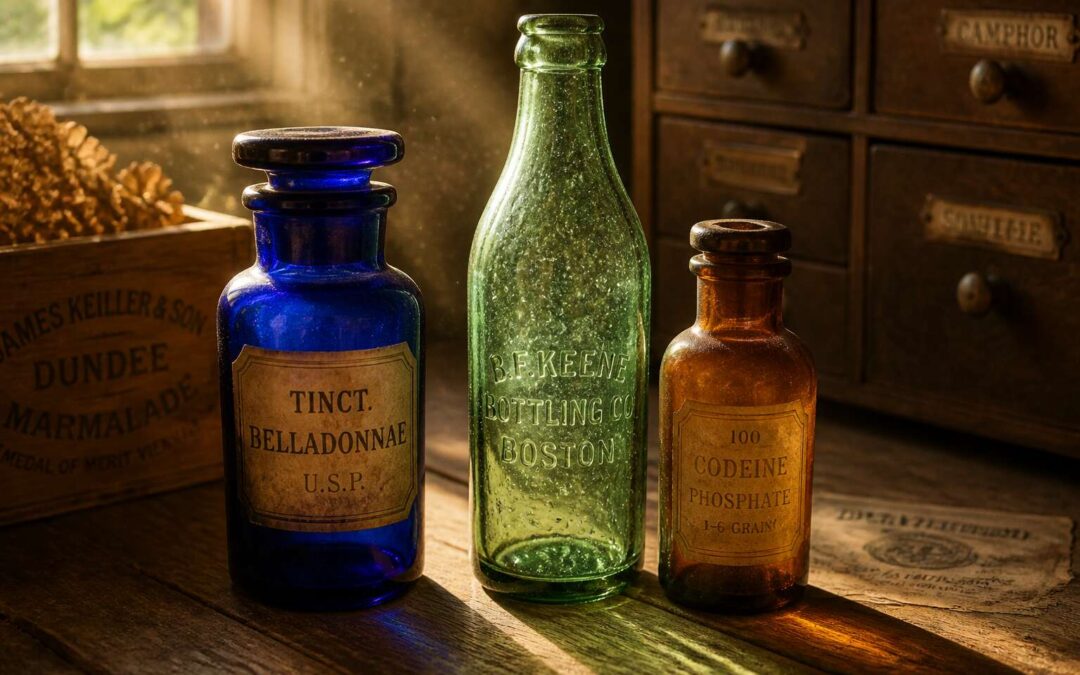
The Ancient Origins of Glass Vessels
Early glassmaking techniques and the first molded containers.
Around 2500 BCE, Mesopotamian artisans pressed molten glass into molds, creating the first vessels that resemble our modern jars. This technique, known as core-forming, involved shaping a sand core and dipping it into hot glass. The result was small, precious containers for oils and perfumes. A glass bottles link to the past becomes tangible when you hold a Roman unguentarium, its surface still carrying the fingerprints of a long forgotten craftsman.
Early Egyptian workshops refined these methods, producing alabastra and amphoriskoi with intricate trailing patterns. The invention of glassblowing in the first century BCE revolutionized production, but molded vessels remained vital for ritual use. The key stages included:
- Core-forming with a sand and clay base
- Fusing glass threads around the core
- Cooling and polishing the finished vessel
These fragile objects survived for millennia, offering us a glass bottles link to the past that no written record can match.
How seafaring merchants spread glassware across the Mediterranean.
Phoenician merchant fleets made glass a Mediterranean commodity. Their ships carried raw ingots and finished vessels from the Levant to Iberia, trading along coastal routes that connected dozens of ports. A glass bottles link to the past survives in the Uluburun shipwreck, where 175 glass ingots rested in a Bronze Age hold for over three thousand years.
These traders understood the economics of weight. Precious cargo took little space, so profits stayed high.
- Negotiating passage through rival ports
- Exchanging glass for copper and tin
- Building relationships with local elites
By the sixth century BCE, Rhodes and Cyprus became redistribution hubs. The glass bottles link to the past grows stronger with every wreck we excavate, every merchant ledger we decipher. What amazes me is how consistently these fragile objects appear in the most unexpected places, from Egyptian tombs to Iberian hillforts!
The shift from core-forming to blowpipes and mass production.
Around the first century BCE, Syrian craftsmen introduced the blowpipe, and glass production changed forever. Core-forming had demanded patience, each vessel wound around a clay core over hours. The blowpipe reduced that time to minutes. A glass bottles link to the past is visible in the thin, symmetrical walls of Roman unguentaria, which could be produced by the dozen in a single furnace session. I find it remarkable that this single invention democratised an entire material.
The consequences were social as much as technical. Glass moved from elite luxury to household utility. The shift created:
- Molds for repeatable shapes
- Workshops clustered near raw materials
- Lighter vessels that lowered transport costs
By the early empire, factories in Sidon and Alexandria shipped glass bottles across three continents. The glass bottles link to the past persists in every recycled jar, a lineage of breath and fire that began with a simple tube!
Notable ancient glass pieces unearthed in archaeological digs.
Some discoveries arrive with a spectral presence. In a necropolis near Alexandria, excavators uncovered a perfume flask sealed after two thousand years. The liquid inside had hardened into amber sediment, but the vessel remained flawless. A glass bottles link to the past becomes physical in that moment, a fragile survivor of hands now vanished. The cobalt blue surface caught lamplight with a silent gleam.
- The Portland Vase, a cameo masterpiece depicting tangled myths
- The Lycurgus Cup, which shifts from green to red when illuminated from within
These were not everyday jars. They served as offerings, protective charms, or displays of wealth. At Begram, Afghanistan, excavators found a hoard of painted flasks imported from Mediterranean workshops, each a relic of trade routes. I marvel at the human residue on such objects. That glass bottles link to the past remains unbroken through neglect, burial, and the slow erasure of memory!
Bottles as Time Capsules of Daily Life
Wine, oils, perfumes, and medicines stored in historic bottles.
Archaeologists often find bottles intact when other objects crumble. These containers hold traces of what people actually consumed. Wine residue, olive oil stains, perfume dregs, and medicinal tinctures survive inside the glass. For historians, this is a direct sample of daily life.
I once handled a Roman unguentarium that still smelled faintly of spikenard. The scent was two thousand years old. That moment made me understand why these vessels are so valuable. They preserve the mundane details that written records ignore.
A glance at bottle contents reveals patterns:
- Imported wine marked wealth and social status.
- Local oils indicate household production and trade networks.
- Perfume bottles often carry traces of exotic ingredients from distant regions.
- Medicine phials show which ailments people feared most.
Glass bottles link to the past in a tangible way. The contents connect us to the routines of ordinary people across centuries. When we uncork a replica, we touch the same rituals that governed households in ancient times.
Identifying glasshouses through embossed logos and design quirks.
A broken bottle from a Cape Town rubbish pit offers detailed evidence for daily trade. Embossed lettering on the base or shoulder names the glasshouse, and quirky flaws seal the identification. These flaws include a lopsided lip, a veering mold seam, or a pontil scar. Such details let you pinpoint a factory in Somerset West or a competitor in Durban within a decade.
- Base embossing with the maker’s initials or city
- Mold seams that vary in width and depth
- Neck rings with unusual tapering
Such marks help glass bottles link to the past, showing what local shelves held. A thick beer bottle with a coarse lip suggests a small brewer; a delicate medicine phial with crisp letters points to a major producer. Daily habits, from buying soda to storing castor oil, leave these physical remains behind, and glass bottles link to the past in every shard.
How bottle silhouettes evolved with changing consumption habits.
Nothing records a buying pattern like a bottle’s outline! In 1910, Cape Town households reused everything. Bottles arrived thick and squat because they survived repeated trips to the dairy. A century later, disposable culture stretched them into tall, thin cylinders meant for one sip and a bin.
That evolution is not random. It tracks refrigeration, car ownership, and even television advertising.
- Wide-mouthed jars narrowed into pouring necks as households switched from scooping to pouring.
- Round beer flagons flattened into stackable crates when rail transport demanded compact loads.
These shapes are measurable evidence. When you hold a bottle, you hold proof of daily routines, and glass bottles link to the past without a single label intact.
Using glass hues to date bottles from different centuries.
Before 1850, nearly every bottle that passed through Cape Town hands was dark green or brown. Iron in the sand stained the glass, and nobody considered that a flaw. A bottle’s color reveals its century more reliably than its shape or wear. When glassmakers added manganese to clarify the mix, they produced pale aqua. Cobalt oxide made deep blues for poison bottles and medicine vials in the 1880s. Clear flint glass, once difficult to refine, only became standard after 1920. We can read all of this in a single shard. These glass bottles link to the past with nothing but their tint intact. Hold a fragment to the light!
- Olive and black glass, the 1700s
- Aqua and green, the 1860s to 1900
- Cobalt blue, the 1880s onward
- Clear flint, after 1910
Each hue records the chemistry of its era. For collectors and historians, glass bottles link to the past through color as much as shape.
From cork and wax to crown caps and screw threads.
The crown cap pops off with a satisfying snap. That sound is barely a century old. Before it, most bottles demanded negotiation, and every drinker knew the risk of a slipped knife.
Cork and wax sealed the first commercial bottles. They kept air out but required a corkscrew and a steady hand. Opening was a ceremony. By 1892, the crown cap replaced that ceremony with a coin and a lever. Soda water became street food. Beer left the cellar for the train platform. The screw thread, perfected after 1910, removed tools.
Each closure changed the pace of daily life:
- Cork and wax: slow, deliberate, for cellar and apothecary shelves
- Crown caps: fast, public, for taverns and railway kiosks
- Screw threads: domestic, convenient, for pantry and picnic basket
Glass bottles link to the past through these small mechanical details. The thread on a sauce bottle, the crimp on a beer cap, the wax on a medicine vial. These are the physical traces of daily life.
Digging Up History: Bottles in Archaeology
What trash pits and privies can teach about colonial life.
Every colonial trash pit hides a record of daily life. When I sift through privies in Cape Town, I find glass bottles tossed aside centuries ago. These glass bottles link to the past through their marks, stains, and broken edges. A single fragment reveals what a household drank, how it treated fever, and which routes reached the Cape.
Concrete data emerges from the glass. Base thickness shows pressure resistance. Neck residue holds traces of oil or vinegar. Bottle size indicates volume consumed per household. Glass colour dates the deposit. Pit location reveals where people socialised or worked.
Even a broken bottle carries meaning! Its depth, the surrounding rubbish, and the way it shattered all point to a specific moment. Reading these clues lets archaeologists reconstruct what history books omit.
Recovered glass bottles as evidence of global commerce.
Archaeologists in Cape Town recovered a case bottle from the 1697 wreck of the Oosterland. The green glass matched a glasshouse in Antwerp. Its contents left tannin stains inside the neck. That object traced a route from Europe to Africa to Asia. This is how glass bottles link to the past. They are records of trade between distant economies.
Read the marks on a recovered bottle:
- Pontil scars from the blowing rod
- Bubble clusters from hasty annealing
- Rim diameters from regional standards
When I catalogue these fragments, I can trace the movement of cargo ships. A Dutch gin bottle found in a Bo-Kaap cellar confirms the scale of East India Company exports. A French wine bottle excavated near the Castle of Good Hope reveals private trade that bypassed official channels. Each vessel is a ledger entry in colonial commerce. No diary states this plainly. The glass bottles link to the past through their chemical fingerprints and wear.
Using typologies of bottle bases and lips in field research.
Typologies of bottle bases and lips are among the field archaeologist’s first tools. When I pull a fragment from a trench, I check the base for a pontil scar or a smooth kick-up. The lip tells me whether the bottle was finished with a string rim or a hand-applied collar. Each feature narrows the date of manufacture.
The diagnostic list is short but precise:
- Pontil scars indicate pre-1850 blowing methods
- Wide, flat lips suggest imported wine bottles
- Deep kick-ups point to high-alcohol spirits
In Cape Town’s urban fills, these typologies are how glass bottles link to the past. A base fragment from a Buitengracht excavation can be matched to a known glasshouse catalogue. A lip profile can date a privy fill within a decade. That precision matters when the soil itself offers no other clues.
Cleaning, stabilizing, and reconstructing fragile glass finds.
Few moments in the field rival the first glimpse of a glass shoulder emerging from the dirt. That fragile curve, often encrusted with centuries of soil, demands a gentle hand. Cleaning begins with soft brushes and deionised water, lifting sediment without scratching the weathered patina.
Stabilisation comes next. Crizzled glass, weakened by chemical decay, sometimes needs a consolidant like Paraloid B72 to hold flaking layers together. Then the reconstruction phase takes over. I follow a careful sequence:
- Dry every shard completely before handling.
- Test fit edges without adhesive to map the vessel’s geometry.
- Apply conservation grade epoxy in tiny dots along each seam.
- Support the joins with fine sandbags while the adhesive cures.
This work transforms a pile of shattered fragments into a shape that can be measured and studied. Every break line carries evidence of pressure, burial, and age. In that careful mending, glass bottles link to the past more directly than any catalogue entry ever could.
Collecting Heritage Glassware
The appeal of Victorian, Art Deco, and mid-century bottles.
One Victorian medicine bottle, scratched and cloudy, sold for R4,500 at a Johannesburg estate sale last year. That price reflects more than rarity. Collectors chase the tactile memory of daily routines, from compounding pharmacies to temperance bars. Art Deco perfume flagons bring geometric elegance, while mid-century soda bottles capture a rising consumer culture built on speed and convenience.
- Victorian: pontil scars, deep cobalt, hand-applied lips
- Art Deco: stepped shoulders, frosted panels, pastel glass
- Mid-century: minimalist necks, screw threads, bold labels
Holding each piece offers a direct encounter with vanished manufacturing methods. For South African collectors, these artifacts form a glass bottles link to the past, tying Cape Town kitchens to 1920s Paris or 1960s Detroit. The pursuit, from flea market stalls to online auctions, turns every acquisition into a quiet archaeological act.
Spotting modern fakes through seams, wear, and glass chemistry.
Heritage glassware tells a story, but fakes can rewrite it. Machine-made reproductions often betray themselves through seams that are too sharp, while authentic pieces show years of handling smoothing those ridges. Glass chemistry offers another clue: old glass holds tiny bubbles and irregular tints, whereas modern copies rely on uniform compounds. I always check the wear patterns first. Genuine bottles develop a distinctive surface etch, not an artificial scuff. Look for these markers:
- Seams that disappear into the glass texture
- Base wear that follows natural use patterns
- Color shifts from manganese or iron impurities
Each flawed detail becomes a witness. These fragile markers keep our glass bottles link to the past honest, protecting the material memories collectors treasure.
Flea markets, estate sales, and online auction platforms.
Flea markets reward early risers, but the true gems hide under dusty tables. I once uncovered a cobalt blue poison bottle nestled between faded postcards. Estate sales tell a family’s story through accumulated glass, while online auction platforms connect you to sellers across continents. Each venue demands a different eye. Condition becomes harder to judge through a screen, so I rely on detailed photographs and honest seller descriptions.
Here is what I weigh before buying:
– Surface scratches under direct sunlight
– Original finishes versus modern polishing
– Shipping costs and packing materials
Every piece carries traces of its journey. These glass bottles link to the past, preserving the hands that once held them. What a thrill when the search pays off! That connection makes the hunt entirely worthwhile.
Rarity, condition, provenance, and demand in the collecting community.
Only a fraction of surviving glassware retains a documented chain of ownership. Provenance often multiplies value more than any physical flaw subtracts. A bottle from a known Cape Town apothecary, with a faded label and a family letter, commands attention that an identical unmarked piece never will. These glass bottles link to the past.
Rarity alone does not dictate demand. Collectors chase pieces that fill a narrative gap, a unique mould seam or a colour batch that lasted one season. Condition remains the final arbiter. I have watched seasoned collectors pass over a rare specimen with a hairline crack, choosing a common piece in mint condition.
When I gauge demand for these glass bottles link to the past, I look for these provenance markers:
- Original embossed marks matching known glasshouse records
- A documented chain of custody from auction receipts
- Physical wear patterns consistent with the stated era